


The Leathery Labels
There are a few materials in the world that have as rich and varied a history as that of leather. Its use in everyday life dates back to thousands of years. What’s surprising is it not only staying relevant but increasing in relevancy. The material is even popular and enjoys a wider variation than ever before.
However, over recent years, the consumer has realized their role in the marketplace. They are now hesitant to purchase products that are not environmentally sustainable. That’s why its alternative has become much more demanded in recent years. With that, so has the question,’How to clean synthetic leather?’
A fake – or faux, imitation – leather is an alternative to its organic counterpart. It is growing in popularity, is relatively affordable, and sustainable for the environment in the long run. Moreover, its maintenance cost is relatively lower as well.
Having said that, it does not mean that it does not require attention. On the contrary, it requires an attentive and careful owner to take care of it in order to maximize its lifespan and quality. To that end, questions like ‘How to clean synthetic leather?’ are incredibly important.
What Is The Alternative
For centuries, people would indulge in the exotic texture and smoothness of processed hides for either luxury or due to its functionality. However, with time people realized the consequences of their increasing consumption habits. That’s when an alternative entered into the market.
Before we explore how to clean synthetic leather, it is essential to understand what it is first. In order to maintain it properly, one needs to understand what they are dealing with.
Synthetic leather is typically a fabric base coated with a layer, possibly layers, of plastic or polymer. That indicates PVC, polyurethane, etc. Its purpose is to imitate the original version as closely as possible. This includes both how it looks and how it feels.
Difference Between The Old & New
It is also important to understand how the two differ from each other. First, the fake version does not breathe the same way as its original counterpart. Though some may not give much heed to breathability, it is a crucial element of what made its predecessor’s fame unrivalled.
Secondly, it is likely to possess more durability to moisture and cleaning than some leather items.This makes an attractive option to many. However, such people should remain wary of their own vulnerabilities which need proper attention.
Thirdly, an error on the part of the owner who either cleans it improperly or using incorrect, harsh chemicals can prove disastrous. The product’s coating will degrade rapidly causing it to peel, crack, or discolor. Now that we have a solid understanding of what it is and how it differs from the original, we can move towards finding out how to clean synthetic leather.
Why Knowing How To Clean Synthetic Leather Is Important
Regardless of what type of faux products one owns, it is important to understand why its maintenance is of the utmost importance. This includes owners of jackets, sofas, or a PVC-coated handbag. Regular attention towards its upkeep prevents bigger headaches down the line. Here are ways in which the products may suffer from negligence.
- Everyday contact with skin oils, makeup, environment dust, spills impacts the product in negative ways. This may lead to a dull surface or stains. That’s why it’s important to be aware of dust, dirt and oils.
- Sometimes stains are unavoidable as accidents occur everyday. However, ignoring for a long time may lead to the spill setting. Then, it becomes significantly harder to solve the problem without damaging the material itself.
- Even though it is mentioned earlier that this version is easier to maintain, that does not mean it’s free from aging. Drying, cracking and peeling are possible outcomes that will cause the material to lose its flexibility. Hence, causing it to appear old and raggedy.
- Like all products, the menace of discoloring looms of this material as well. Dark clothing rubbing against light faux leather or prolonged UV sunlight can cause visible damage.
How To Clean Synthetic Leather: A Step By Step Analysis
Now that we have covered all the basics, let’s dive into the process of cleaning and maintaining it. This process is applicable to almost every item of such material
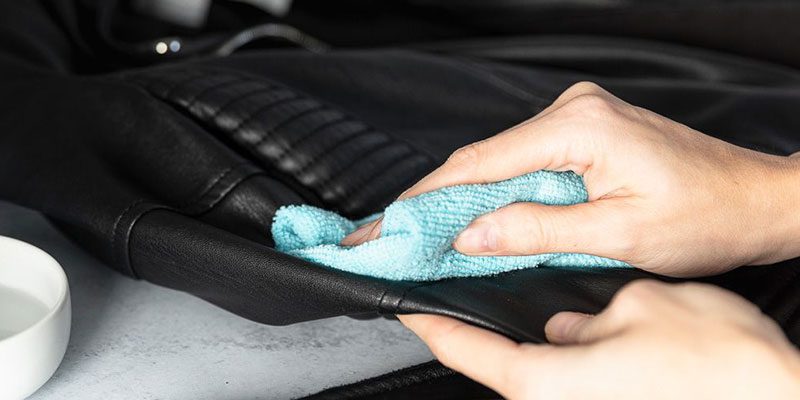
- Dust and Wipe: The first step towards cleaning it remains removing any loose dust or debris just like for the original version. However, it is important to use a soft microfiber cloth that’s either completely dry or slightly damp.
Use it to gently wipe and remove any dirt. On the other hand, furniture may require using a soft brush attached to a vacuum for picking up dust from its seams. - Prepare a Mild Cleaning Solution: The safest route for general cleansing is using a neutral detergent in warm water. Alternatively, a mild soap may also be fit for the task at hand. An example of it is mixing a few drops of dish soap in a bowl of warm water.
Then, damp the microfiber cloth delicately in the solution and test on a small area before starting the process in its entirety. - Wipe the Surface Gently: It is important not to be too rough on the product itself. Using a gentle hand in circular motions whilst paying acute attention to seams, textures, and spots that have gotten heavy wear.
Additionally, it is advised not to use heavy scrubbing, rough sponges, or abrasive brushes. These may likely do more damage than good and ruin the whole maintenance. - Rinse and Dry: After completion, switch a clean cloth that’s damped with only clean water. Use it to rinse off any remaining solution residue on the surface. Next, immediately dry it with a soft,dry cloth at the end.
Any moisture, be it from the solution or just water itself, may weaken the material over time if ignored. Let the item air-dry fully in a well-ventilated area, away from direct heat or sunlight. - Spot Clean Tough Stains: After letting the item dry in a ventilated area away from heat and sunlight, it is ready for use again. However, sometimes a stubborn spot may require more than the normal effort.
In the case of ink spots, a diluted isopropyl alcohol (70-90%) mix is helpful as normally they are included in cleaners to avoid using faux leather. However, extreme caution is advised when dealing with it. For grease, the above process would do the trick. Lastly, for color transfer, cleanly gently is of utmost importance. Rubbing it forcefully may push the dye deeper.
Conclusion
All in all, questions like. ‘How to clean fake leather?’ or ‘How to clean imitation leather?’ all have the same process as described above. Although there are many myths and traditional methods that are widely used, we recommend opting for the certified process explained here.
Knowing how to care for and maintain faux leather is essential for anyone owning it and likely leads to an extended lifespan of the product. Hence, you can keep enjoying the utility of a product without worrying about degradation.
